
If you’ve ever come across a cat that looks like a beautiful, chaotic masterpiece of stripes, patches, and swirls, you might have been looking at a Tabico. On our platform, Cat Thesis, we love diving deep into the science behind feline beauty. Today, we are exploring the fascinating world of Tabico cat genetics.
While many people think “Tabico” is a specific breed, it is actually a unique coat pattern. Tabico cats share many visual traits with the Calico Cat, including their famous ‘attitude’ or personality.By the end of this article, you’ll understand exactly how these stunning cats get their looks and why they are a genetic marvel.
What exactly is a Tabico Cat?
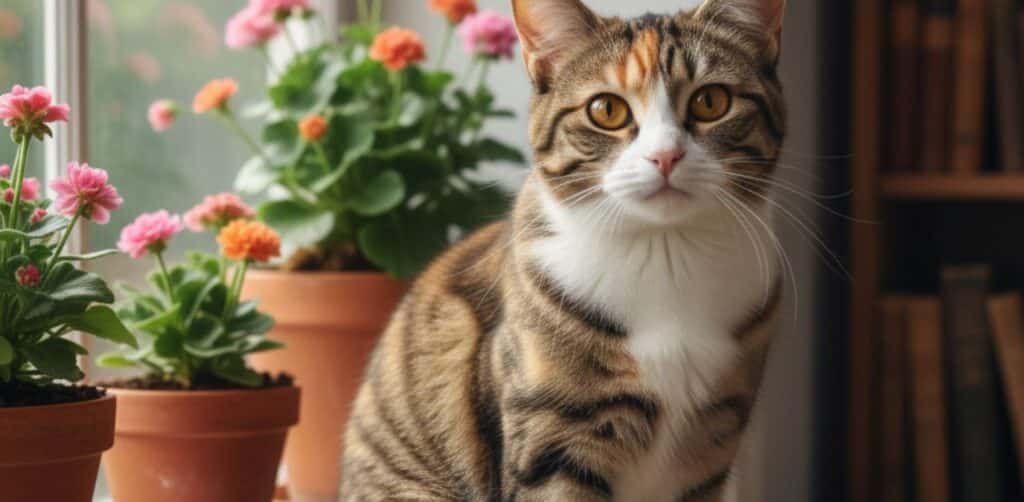
The name “Tabico” is a “portmanteau”—a blend of two words: Tabby and Calico.
To understand a Tabico, you first need to know its parents’ patterns:
- Calico: A cat with three colors (usually white, black, and orange) in distinct patches.
- Tabby: A cat with stripes, dots, or swirling patterns, famously recognized by the “M” shape on their forehead.
A Tabico cat has the tri-color patches of a Calico, but instead of solid black or orange spots, those patches have Tabby stripes. It’s the best of both worlds!
The Core of Tabico Cat Genetics
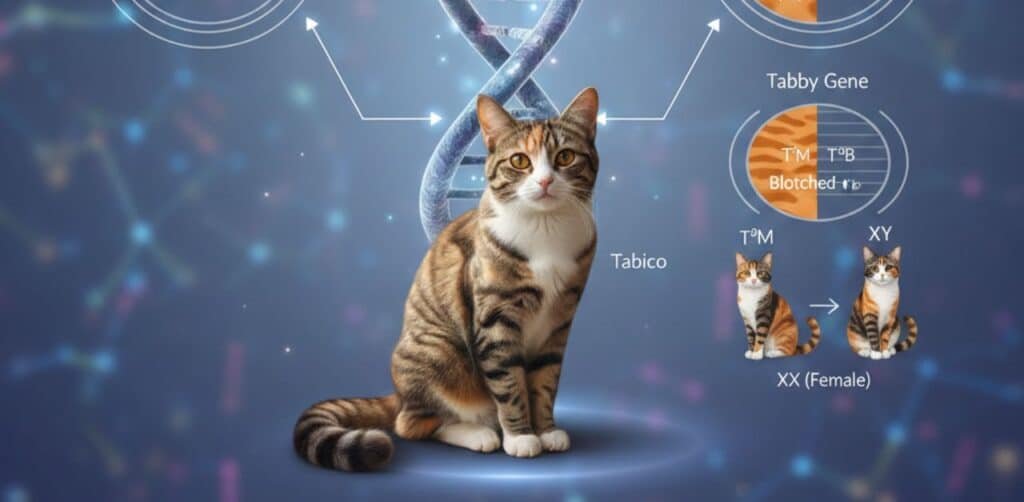
The secret to the Tabico look lies deep within their DNA. To understand Tabico cat genetics, we have to look at how color is inherited in felines.
The X-Chromosome Connection
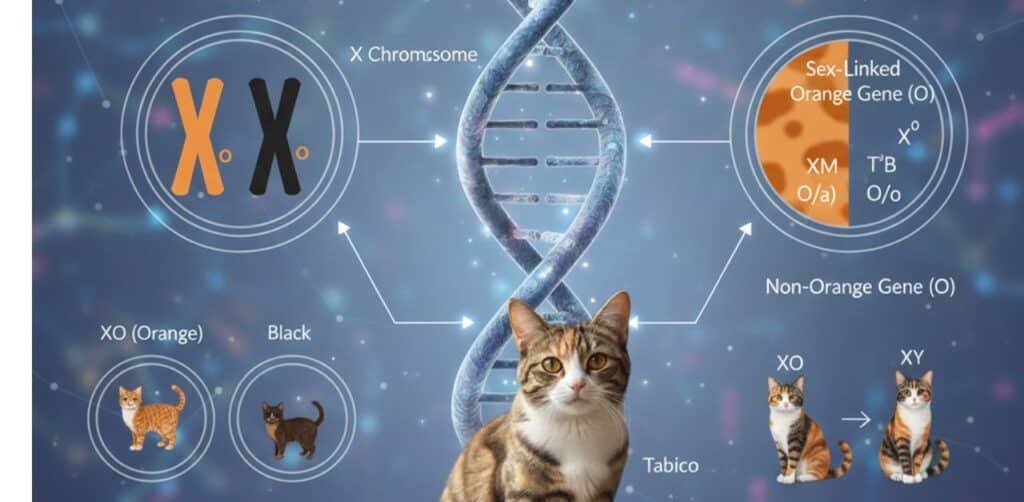
Just like humans, cats have sex chromosomes: XX for females and XY for males. In cats, the gene that determines “orange” or “non-orange” (black/brown) fur is located specifically on the X chromosome.
- A female cat (XX) has two spots for color instructions. She can have one X for orange and one X for black, allowing both colors to show up.
- A male cat (XY) only has one X. He can be orange OR black, but usually not both.
This is why almost all Calicos and Tabicos (about 99.9%) are female!
The Agouti Gene (The Tabby Secret)
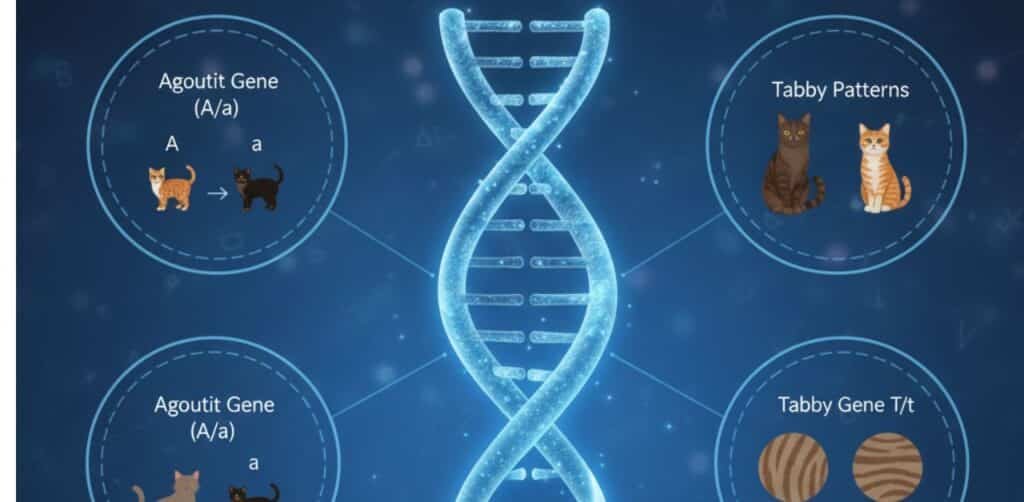
What turns a Calico into a Tabico? It’s the Agouti gene. The Agouti gene determines whether a cat’s coat will have a solid color or a patterned (tabby) look. In a standard Calico, the “non-agouti” gene is present, making the patches solid. However, in a Tabico, the Agouti gene is active, turning those orange and black patches into striped tabby zones.
The Pieballing Gene (The White Patches)

The white fur you see on a Tabico isn’t a color; it’s actually the absence of color. This is caused by the Piebald spotting gene. Depending on how strong this gene is, a Tabico might have just a little white on its paws or a lot of white across its chest and belly.
Why Are Male Tabicos So Rare?
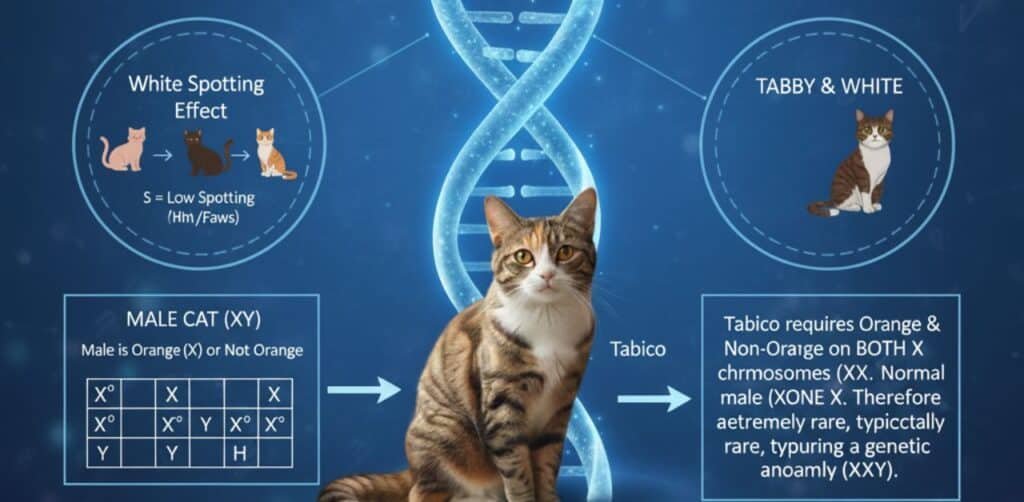
As we mentioned in Tabico cat genetics, the “three-color” rule requires two X chromosomes. For a male cat to be a Tabico, he would need to have an extra chromosome, resulting in an XXY configuration.
This condition is known as Klinefelter Syndrome. While these male cats exist, they are extremely rare (about 1 in 3,000) and are almost always sterile, meaning they cannot father kittens.
Identifying a Tabico: Key Characteristics
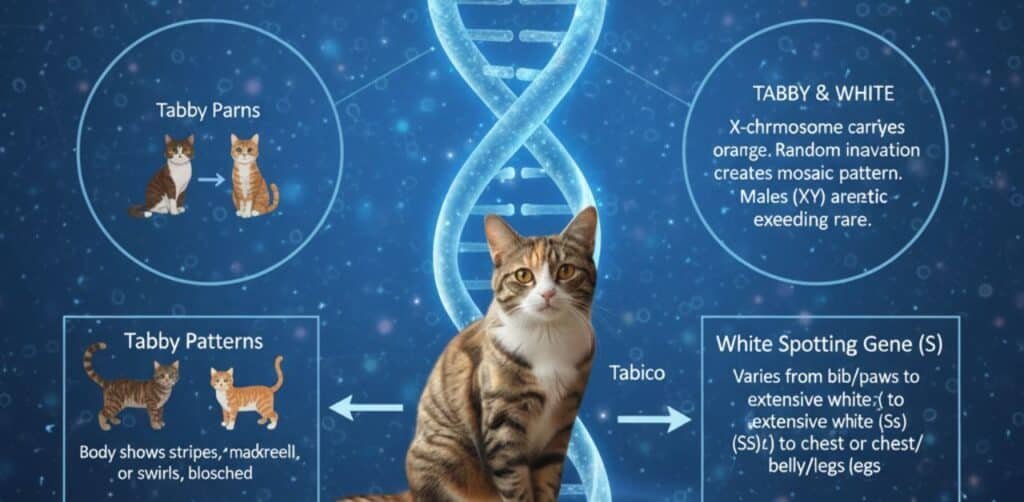
How can you be 100% sure you are looking at a Tabico? Look for these “Cat Thesis” identifiers:
- The “M” Mark: Look at the forehead. A Tabico will almost always have the classic Tabby “M” shape.
- Striped Patches: Look closely at the colored patches. If you see “pencil lines” or “swirls” inside the orange or dark spots, it’s a Tabico.
- White Base: Most Tabicos have a significant amount of white fur, usually on their chest, legs, and underbelly.
- Eyeliner Look: Tabby genetics often give cats a thin line of pale fur around their eyes, making them look like they are wearing eyeliner.
Are Tabicos a Specific Breed?
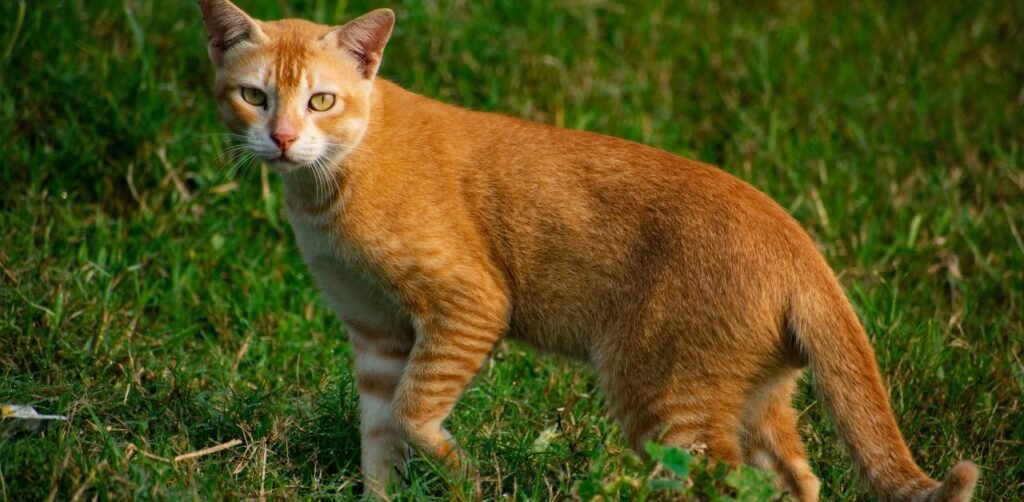
A common misconception in the US is that Tabicos are a breed like Persians or Maine Coons. This is not true. The Tabico is a color pattern that can appear in many different breeds. You can find Tabico patterns in:
- Domestic Shorthairs (the most common)
- American Shorthairs
- Maine Coons
- Munchkin cats
- Japanese Bobtails
Because it’s a pattern and not a breed, the personality of a Tabico usually depends more on its specific breed ancestry than its coat color.
The “Calico-tude” Myth
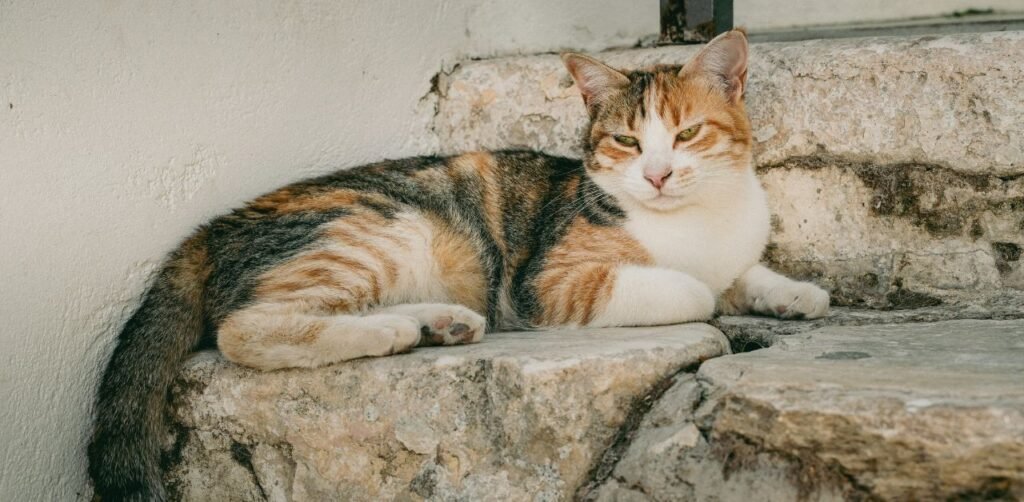
In the cat world, there is a popular theory called “Calico-tude.” Many owners believe that tree-colored cats (Calicos and Tabicos) are more feisty, independent, and vocal.
While there is no scientific proof in Tabico cat genetics that links coat color to personality, many Tabico parents swear that their cats are “extra spicy” and full of character!
Caring for Your Tabico Cat
Whether your Tabico is a rescue or a specific breed, their care requirements are standard but important:
- Grooming: If your Tabico is a long-haired breed (like a Maine Coon mix), they will need daily brushing to prevent mats.
- Nutrition: High-protein diets are best for maintaining that beautiful, shiny tri-color coat.
- Regular Vet Checks: Because most are female, ensure they are spayed early to prevent health issues later in life.